
Unironically Using AI for Alpha Generation, Again.
Four models, one decent idea, zero working alphas. Progress, sort of.

If you have been in the systematic trading space long enough, you know that once you have an idea, getting it to production is a fairly “simple” process. You write the code, formalize the logic, and execute at small scale.
But sometimes, being frank, coming up with ideas is hard.
Sure, every once in a while you pick something up from a market observation, something you read, or a shower thought. But that happens infrequently, and most of those ideas do not pan out anyway.
We’ve been faced with the same problem before, so eventually we decided that if we were going to truly succeed in this business, we needed a way to generate usable ideas in an industrialized, systematic fashion.
Now, the typical school of thought is to just hire a bunch of junior quants that do this full-time, but we wanted something more agile.
In our prior Unironically Using Claude for Quantitative Trading, we established that while these AI tools weren’t great for coming up with novel ideas, they were great for “common-sense” tasks that would traditionally be outsourced to a junior.
That probably still holds, but we couldn’t help ourselves, and decided to try again.
So today, we’ll be taking a good look on how these tools can be guided to generate actually usable alphas, where they fall short, and how edges like these get implemented on a long/short market-neutral desk.
With that being said, let’s get started.
What Are We Even Betting On?
Unlike our first experiment with these models, we have to start from the premise that we don’t already have a pre-formed idea.
So first, we need to think about what actually moves prices to begin with.
In equities, the common school of thought is that stock prices are dictated by earnings and future expectations of those earnings.
This makes sense as there are few other incentives to hold stock other than the earnings it generates or will generate in the future.
So if earnings are the focus, we need three things: historical earnings, their estimates, and their forward expectations. That last one is hard to quantify cleanly, so we’ll use a simple proxy: analyst expectations from the major houses like BofA, Goldman, and Morgan Stanley.
With that as our area to crack, we can stop here and shift to idea generation.
Prompting to Vet, Not Fetch
The naive version of this is to ask a model for alpha ideas and get back a list of named anomalies.
While we don’t need to have an idea that no one else has, if we want to actually get somewhere, it might be good to do something that isn’t already commonly-known and commoditized (e.g., the index rebalancing effect).
So before prompting, we have to intuit a few constraints:
Mechanism-first reasoning
Instead of asking for anomalies, we’ll first ask for plausible reasons a mispricing could exist. If a candidate ends up resembling a known effect, that’s fine; we mainly care about the reasoning process that got it there.
Realistic guardrails
A medium-frequency long/short book with a one-month holding period rules out a large fraction of what an unconstrained model defaults to: no optimistic intraday execution assumptions, no 1-3 day edges that assume you trade at a specific price on a specific day, etc.
Demanding a failure mode
If the model can’t articulate why its suggested edge might not work, it might not be a great one, so we want it to be able to break itself a bit before it brings something back to us.
With those constraints in mind, we can build a prompt that gets us closer to what we need:
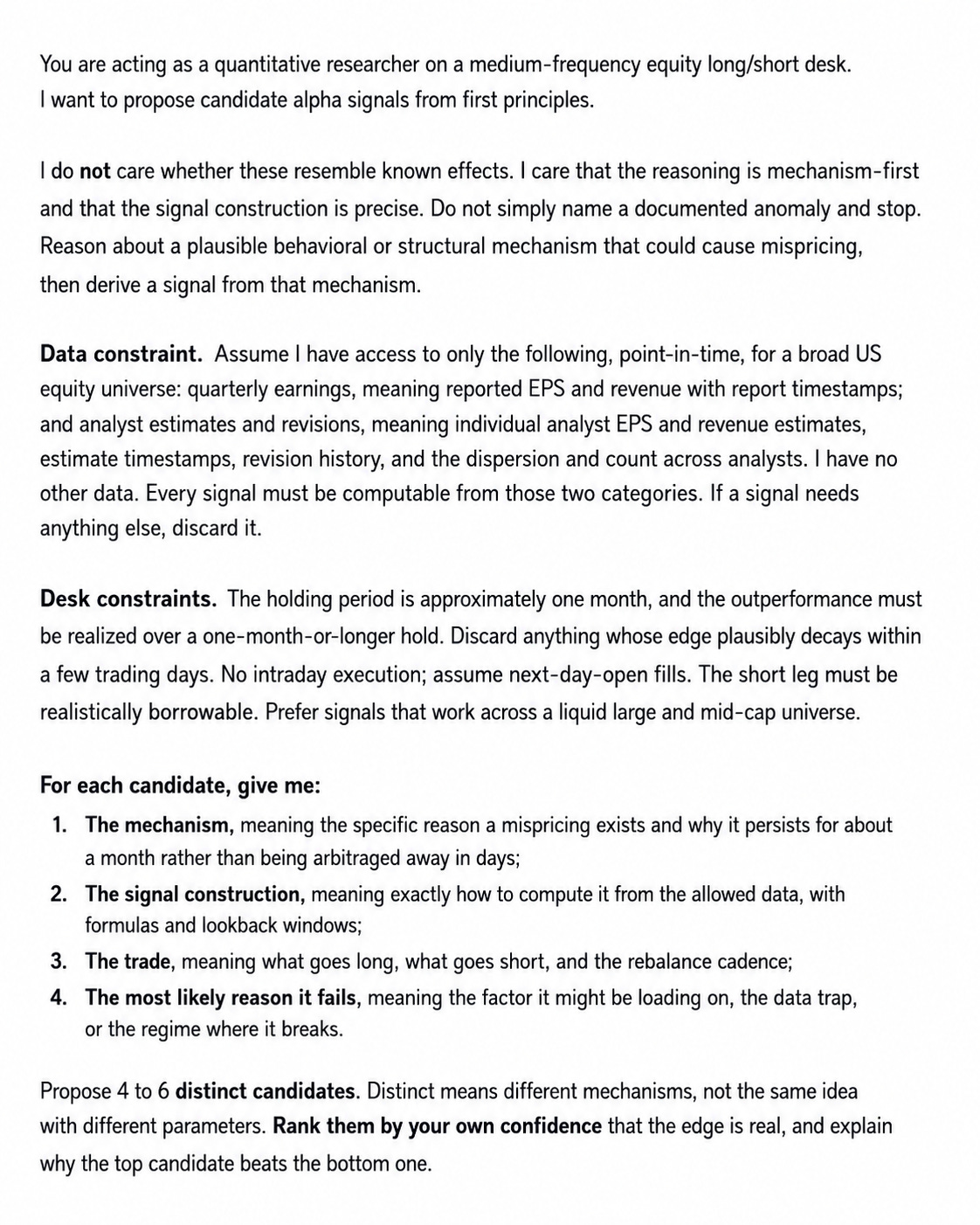
Shopping It Around
The goal here is just idea generation and picking out the best of what comes back, so we shopped the same prompt to all the major models: Claude, GPT, Gemini, and even Grok.
For each, we chose the highest thinking setting available to give ourselves the best shot.
Surprisingly, the outputs were pretty good: